
How CTOs Can Automate Zero-Trust CI/CD and SLSA Without Killing Velocity
Managing domain names is essential for keeping websites and applications running smoothly. Amazon Route53 is AWS's DNS service that handles domain registration, routes traffic, and monitors system health. It offers fast DNS lookups, automatic systems failover, and integrates well with other AWS services, making it a key component of any cloud infrastructure nowadays.
Domain Registration and Management
Route53 allows organizations to buy new domains or transfer existing ones to be managed under the service. It supports multiple TLD domains, such as .com, .net, .cloud, and .gov, among others. Once the domain is registered, the service provides the interface to manage it, delegate it, create subdomains, and associate it with AWS services.
For example, you can buy the domain business.com, and once it’s registered, you can configure a record to point the domain to a load balancer that distributes the traffic between your internal servers.
Routing Policies
Routing policies determine how to respond to queries for your domain. Route53 allows configuring different types of policies based on various criteria, allowing businesses of all kinds to optimize their query performance, improve fault tolerance, customize user experience, or even serve different content depending on other factors, like geography or latency.
Simple Routing
Simple routing (as the name suggests) is the simplest routing policy Route53 offers. It allows configuring one resource in the response, and it’s commonly used for basic applications.
Weighted Routing
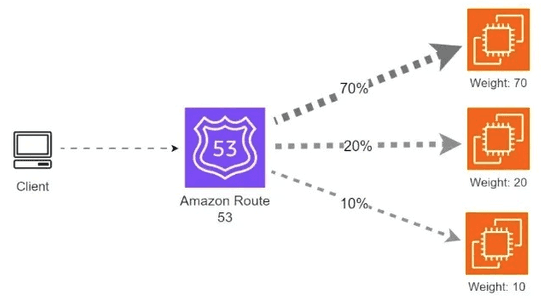
The weighted policy allows answering DNS queries based on a predefined weight that can be assigned inside the policy. Imagine how a Load Balancer works if it uses a round-robin algorithm (distributes traffic equally to all servers behind it - that kind of load balancer can be implemented using a weighted policy in Route53. It only requires assigning the same weight to the destinations inside the DNS record.
Blue-green deployments is another use case for weighted records. Usually, businesses use weighted policies to distribute a percentage of the traffic to the new version for testing it, and once it’s ready, the Blue version becomes the Green.
Latency Routing
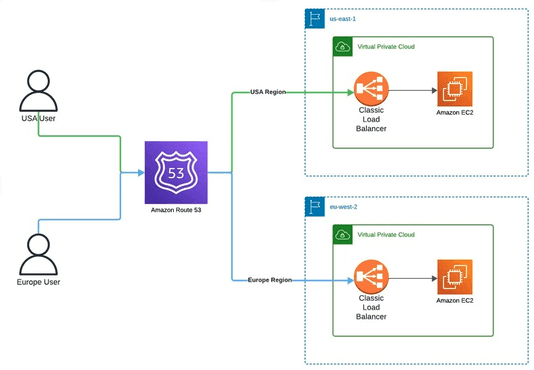
Imagine you have the ability to answer the DNS query with the server that offers the lower latency for the client; this is exactly what latency routing offers. If you have the same application deployed on multiple regions, like us-east-1 and us-west-2, you’d eventually want that if your user is located in the west coast, the request should go to us-west-2 instances, and if it’s on the east cost, it should go to the us-east-1 region.
Latency routing analyzes the latency between the region where you have instances (AWS Data Centers) and, depending on the latency the end-user has between them, it returns the instance with the lowest one.
Geolocation Routing
Geolocation routing allows answering based on the end-user location; suppose your organization needs to serve translated content based on where the user is located. So, if the user is located in the United States, it should serve English content, but if the user is located in Spain, it should serve Spanish content.
This routing mechanism uses the source IP address of the DNS query to identify the source location, and depending on the configuration of the policy, Route53 will answer a different response based on it. It can be configured with a default answer, which is used when Route53 can’t match any location for the source IP.
Geolocation routing allows configuring specific countries, continents, and states, but the last one is only available under the United States.
Other use cases that are common for organizations include using geolocation routing to restrict the distribution of content to only the locations in which the organization has distribution rights.
Failover Routing
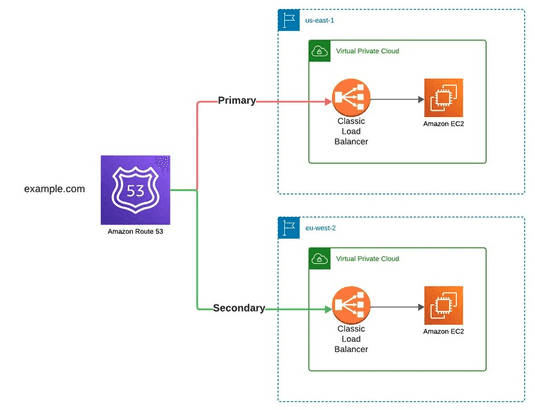
Failover allows routing traffic based on the healthiness of the resource configured in the record. It allows the configuration of a primary and secondary resource; for example, if the primary is marked as unhealthy, the traffic will flow to the secondary resource.
The active-passive failover is the basic use case, but Route53 also allows configuring active-active failover; in the active-active scenario, when all resources are healthy, they will be included in the answer, but if one of them becomes unhealthy, it will be removed until it recovers.
Multi-value Answer
Multi-value answer allows responding to queries using multiple resources, such as IP addresses or CNAMEs. It allows to increase redundancy and can be configured with health-checks to return only the healthy resources. In case all resources are unhealthy, by default, it returns all the resources anyway.
Health Checks and Traffic Flow
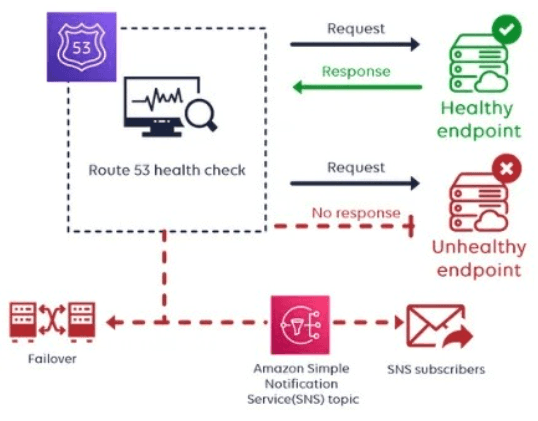
Health checks can check the health of resources; it can be considered a monitored system inside Route53 since it’s the information source for other components. For example, the failover policies need to be associated with a health check to decide on the traffic flow, but the policy itself doesn’t monitor the resource; the health check is who monitors it.
Health checks can be configured to monitor if a web server is available, and all checks are performed over the internet. It can check if the endpoint is healthy, or to be more realistic, it can check if a web application returns a desired web page under a certain URL.
Also, health checks can monitor a group of other health checks and make a decision (true/false) based on the results of the group. Another interesting option it has is the ability to create health checks based on cloudwatch alarms; this opens the game to other kinds of monitoring. Organizations could configure an internal, more detailed health check of the application and post the result as a cloudwatch alarm that the health check will use for the routing decision.
When a resource changes its state in the health check, you can configure it to receive a notification via SNS.
Integration with AWS Services
Route 53 integrates efficiently with the AWS ecosystem, enhancing your organization's cloud infrastructure management capabilities.
The service integrates smoothly with key AWS services, including:
Amazon S3 - Enables custom domain configuration for static website hosting solutions
AWS CloudFront - Facilitates content delivery optimization through strategic edge location caching
Elastic Load Balancing (ELB) - Ensures optimal traffic distribution across your infrastructure
AWS Lambda - Facilitates serverless DNS routing implementations. To illustrate, organizations can implement acomprehensive serverless architecture leveraging Route 53, CloudFront, and S3 to deliver content with enterprise-grade performance.
Pricing Structure
Route53 implements a consumption-based pricing model that considers several key metrics:
Hosted zone allocation
Monthly DNS query volume
Health check implementation requirements
For standard implementations utilizing one domain with one million monthly DNS queries, organizations can anticipate expenditure in the range of $0.50-$1 monthly. Enterprise deployments featuring increased query frequencies or advanced routing architectures may necessitate additional investment.
Implementation Strategies
Here are the key strategies that will ensure optimal performance with Route 53:
Enable Health Checks: Guarantee continuous service by automatically routing traffic away from failing endpoints.
Use Latency-BasedRouting: Deliver superior performance by intelligently directing users to their optimal AWS region.
Implement IAM Policies: Secure your DNS infrastructure with robust access controls.
Utilize Route 53 Resolver: Take full control of private DNS queries in hybrid cloud environments.
Monitor with CloudWatch: Stay ahead with proactive DNS performance monitoring and instant failure alerts.
Implementing these strategies ensures your organization will achieve robust, secure, and optimized DNS management on AWS.
Conclusion
Route 53 is AWS's DNS service that handles domain registration, traffic routing, and health checks. It delivers reliable domain resolution and works seamlessly with cloud applications. The service fits any scale - from basic websites to complex global applications with multiple regions. Its straightforward design makes DNS management accessible and efficient.
At Betta, we help organizations design and implement DNS strategies that are scalable, secure, and aligned with AWS best practices. Whether you're optimizing an existing setup or building from the ground up, we’re here to help you get it right.
" width="205px"/></svg>)


